


The clearest sign of a garage door repair scam is a technician who condemns the entire system within minutes of arriving, before doing any real diagnosis. Most overcharging in this trade does not look like obvious fraud. It looks like a cheap advertised service fee, a friendly technician, and a sudden discovery that the door needs far more work than you thought. The warning signs are subtle by design, because the obvious ones stopped working years ago. Here are the eight that homeowners most often miss, in the order you will encounter them.
Key Takeaways
- The scam usually starts on the phone, not in the driveway. How a company answers the call is your first data point.
- An unusually low advertised service fee is not a bargain. It is a customer acquisition cost that gets recovered on site.
- A technician who diagnoses before inspecting is following a script, not troubleshooting.
- Claims that parts are proprietary or non-standard are one of the most common ways a simple repair becomes an expensive one.
- A price that drops when you hesitate was never a real price.
- Urgency is the mechanism. Real emergencies exist, but a legitimate technician explains and lets you decide.
- Get everything in writing before work starts. Once the door is disassembled, your leverage is gone.
Why This Trade Attracts Them
Three conditions make garage doors unusually attractive to bad operators, and understanding them makes the warning signs easier to read.
The failure is urgent and immobilizing. A broken spring traps a car, which compresses the time a homeowner has to make a decision. Second, almost nobody knows what the parts cost or what the work involves, so there is no internal alarm when a number sounds high. Third, the work happens in a space most people never look at closely, so a claim about the condition of a component is very hard to check.
None of that means the trade is full of scammers. Most companies are ordinary local businesses. But those three conditions mean the ones who do operate badly can do so profitably for a long time, which is why the industry itself has taken up the problem. The International Door Association maintains scam awareness resources for homeowners, with current guidance and a reporting form, and publishes ongoing updates through its industry account on LinkedIn.
This article covers the behavioral signals. For the full vetting process that catches most of this before anyone is dispatched, see How Do You Choose a Licensed Garage Door Company? 10 Things to Check Before You Hire.
1. The Phone Is Answered Without a Company Name
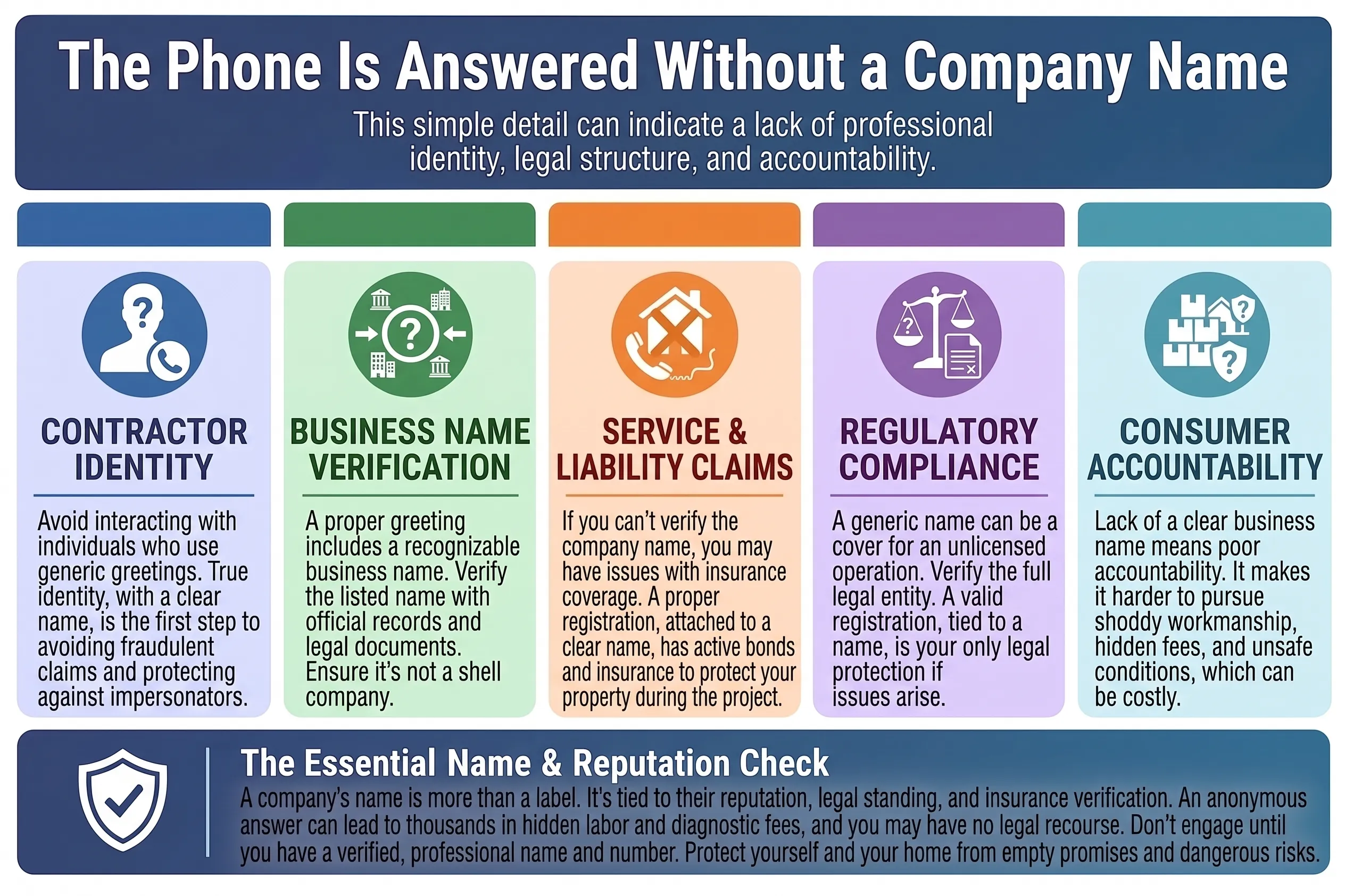
This is the earliest signal and the one almost everyone misses, because it happens in the first two seconds of a call when you are not yet paying attention.
A legitimate local business answers with its name. An operation running multiple advertising fronts answers with something generic, because the person picking up does not know which of several listings you called. A vague greeting is not proof of anything on its own, but it is the first thread worth pulling.
The related tell is a company name that is close to a well-known one, or so generic it could not be searched for. Clopay’s guidance on avoiding garage door scams makes this point directly, noting that fraudulent operations often use generic or inconsistent names and have no verifiable physical location.
Why the Way a Garage Door Company Answers the Phone Matters
Ask for the full legal business name and the physical address on the call. A real business gives both without hesitation. Write them down and search them before the technician arrives.
What to do: if the name is vague or shifts during the call, get another quote before booking.
2. The Advertised Service Fee Is Unusually Low
A service fee far below what everyone else charges is a marketing expense, not a discount. The company has decided to buy the visit and recover the cost once a technician is standing in your garage.
The economics only work if the average job ends up much larger than a service call. That pressure does not disappear because the technician is pleasant. It is built into the structure of the business.
This does not mean a low fee always signals a problem. Plenty of legitimate companies waive or credit the service fee toward the repair. The question that separates them is simple and worth asking on the phone: is the fee credited toward the work, and what exactly does it cover?
Is a Cheap Garage Door Service Call Fee a Red Flag?
Only in context. A low fee plus a vague company name plus reluctance to quote anything else on the phone is a pattern. A low fee from a company you have verified is just a low fee.
What to do: ask whether the fee is credited to the repair, and get the answer before booking.
3. The Diagnosis Arrives Before the Inspection
This is the single most reliable sign, and it is the one the title of this article is really about.
A real diagnosis takes time. A technician should run the door, listen to it, check the balance by disconnecting the opener and lifting manually, inspect the springs and cables, look at the rollers and track alignment, and test the safety reversal. That is several minutes of work before anyone should be quoting anything.
A technician who walks in, glances at the door, and announces that the whole system needs replacing has not diagnosed anything. They have delivered an opening position.
The tell within the tell is scope. Most garage door faults are single-component failures. A broken spring, a frayed cable, a misaligned sensor, a worn roller, a failed logic board. Whole-system replacement is occasionally the right answer, and the legitimate signs that a door needs replacing rather than repairing are real, but they are about age, rust, panel damage, and repeated failures, not about a door that stopped working this morning.
How Long Should a Garage Door Diagnosis Take?
Long enough for the technician to actually operate the door and check its balance by hand. If a quote arrives faster than that, ask what specifically failed and ask to be shown it.
What to do: ask them to show you the failed part and explain what it does. A real technician enjoys this question. A script does not survive it.
4. The Parts Are Described as Proprietary or Non-Standard
This one costs homeowners the most money, because it sounds technical enough to be true.
Garage door hardware is overwhelmingly standardized. Torsion springs come in standard wire sizes, inside diameters, and lengths. Rollers, hinges, cables, and drums are commodity parts. A technician telling you your springs are a special type that only they can source is, in almost every case, describing an ordinary spring.
The same move appears with openers. A claim that a unit is obsolete and unrepairable is sometimes true, since logic boards on older units genuinely do become unavailable, but it is also the fastest route from a small part to a full replacement. It is worth knowing in advance when opener repair makes more sense than replacement, because the answer is not always the expensive one.
If you want to sanity-check a claim about a specific component, garage door spring repair and opener repair are both routine, well-defined jobs rather than exotic ones.
Are Garage Door Springs Proprietary Parts?
Almost never. They are manufactured to standard specifications and are widely available. Treat a proprietary-parts claim as a prompt for a second quote rather than as information.
What to do: ask for the specification of the part being installed, including the spring’s cycle rating. Vagueness here is the answer.
5. Work Starts Before You Approve a Written Price
The moment the door comes apart, your position changes completely. You can no longer decline, because you now have a disassembled door and a technician holding the parts.
This is not always deliberate. Some technicians genuinely start working out of momentum. But the outcome is the same, and a company with good practices does not let it happen, because the written estimate protects them as much as you.
A usable estimate names the specific parts, the labor charge, the service fee and whether it is credited, the total, and the warranty term. If it says “garage door repair” and a number, it is not an estimate. If it is spoken rather than written, it is not an estimate either.
Should I Get a Written Estimate Before Garage Door Repair Starts?
Yes, without exception, and before anything is removed from the door. This is the single most effective protection available to you and it costs nothing.
What to do: say clearly that you want the price in writing before work begins. Any legitimate company does this as standard.
6. The Payment Terms Are Unusual
Pay attention to how you are asked to pay, not just how much.
The patterns worth noticing: a demand for cash specifically, a large deposit before any work, a request to pay before the job is finished, or payment routed to a personal account or a name that does not match the company. Card payment on completion against an itemized invoice is the normal arrangement, and anything that deviates from it deserves a question.
Unusual payment terms also tend to travel with an absence of the financial backing that makes a complaint meaningful later. A registered contractor carries a bond and insurance precisely so there is something behind the transaction, and Should a Garage Door Company Be Bonded and Insured? 5 Coverages to Confirm First covers what each of those actually protects.
Should I Pay Cash for Garage Door Repair?
Card payment against an itemized invoice gives you a record and a dispute path. Cash gives you neither. If a company will only take cash, that preference is information about the business.
What to do: pay on completion, by card, against a written invoice.
7. The Price Drops When You Hesitate
If a number falls sharply the moment you mention a second opinion, it was never a real number.
Legitimate pricing is based on parts and labor, so it does not have much room to move. A quote that can be cut substantially on the spot was built with that room deliberately included.
The same logic applies to today-only pricing and discounts that expire when the technician leaves. Real businesses do run promotions, but a genuine promotion is advertised in advance and is the same for everyone. One that materializes in your driveway in response to your reluctance is a negotiating tactic.
This is where urgency does its work, and it is worth separating manufactured urgency from the real kind. Some failures genuinely do need same-day attention, and the real urgency behind emergency garage door repair is a useful reference for telling which is which.
Why Do Garage Door Repair Prices Drop When You Say No?
Because the original figure had negotiation built into it. A price constructed from actual parts and labor does not have that flexibility.
What to do: treat a large on-the-spot discount as a reason to leave, not a reason to accept.
8. Nothing Is Left Behind at the End
The last sign is the one people notice only afterward, once there is a problem and nothing to point at.
When the job is finished you should have an itemized invoice listing the parts installed, a written warranty covering parts and labor with a stated term, and the company’s full legal name and contact details on both documents. Ideally you should also know what was replaced and be able to see it.
A job that ends with a verbal total and no paperwork has left you with no way to make a warranty claim, no evidence for a dispute, and no record of what is actually on your door. The absence is the point.
What Paperwork Should I Get After a Garage Door Repair?
An itemized invoice and a written warranty, both carrying the company’s legal name. Ask for them before you pay rather than after.
What to do: do not release payment until the paperwork is in your hand.
What a Scam Sounds Like vs. What a Real Company Sounds Like
|
Moment |
Scam |
Legitimate |
|
Answering the phone |
Generic greeting, no company name |
Names the business immediately |
|
Asked for registration number |
Deflects, or promises the tech will bring it |
Reads it out on the call |
|
Service fee |
Unusually low, terms unclear |
Stated plainly, credited or not, no ambiguity |
|
On arrival |
Quotes within a minute of looking |
Operates the door, checks balance by hand |
|
Scope |
The whole system needs replacing |
Names the specific failed component |
|
Parts |
Proprietary, special order, only we have them |
Gives the spec and the cycle rating |
|
Estimate |
Verbal, or written after work starts |
Written and itemized before anything is touched |
|
You hesitate |
Price drops, deadline appears |
Leaves the quote with you |
|
Payment |
Cash, deposit up front, personal account |
Card on completion against an invoice |
|
Afterward |
Verbal total, no documents |
Itemized invoice and written warranty |
Business Owners Are Targeted Too
Commercial properties see a version of this with higher numbers attached, because a door that will not open costs a business money every hour it stays shut. That pressure is exactly what the tactics in this article are designed to exploit.
The signs are the same, but two additions matter. Ask for a certificate of insurance naming your business, and be cautious about any contractor who proposes a full replacement on an urgent call. An overhead door repair on a dock door is frequently a component failure rather than an end-of-life event, and overhead door replacement is a planned project with lead times, not something to decide under pressure on a Tuesday afternoon.
The structural defense for a business is scheduling rather than vetting. A contractor already handling routine door maintenance across your openings knows the equipment, which removes the information gap the tactics depend on. The same applies at the start of the relationship, where an overhead door installation done by a contractor you have verified means the service history begins with someone accountable.
What to Do If You Think You Have Been Scammed
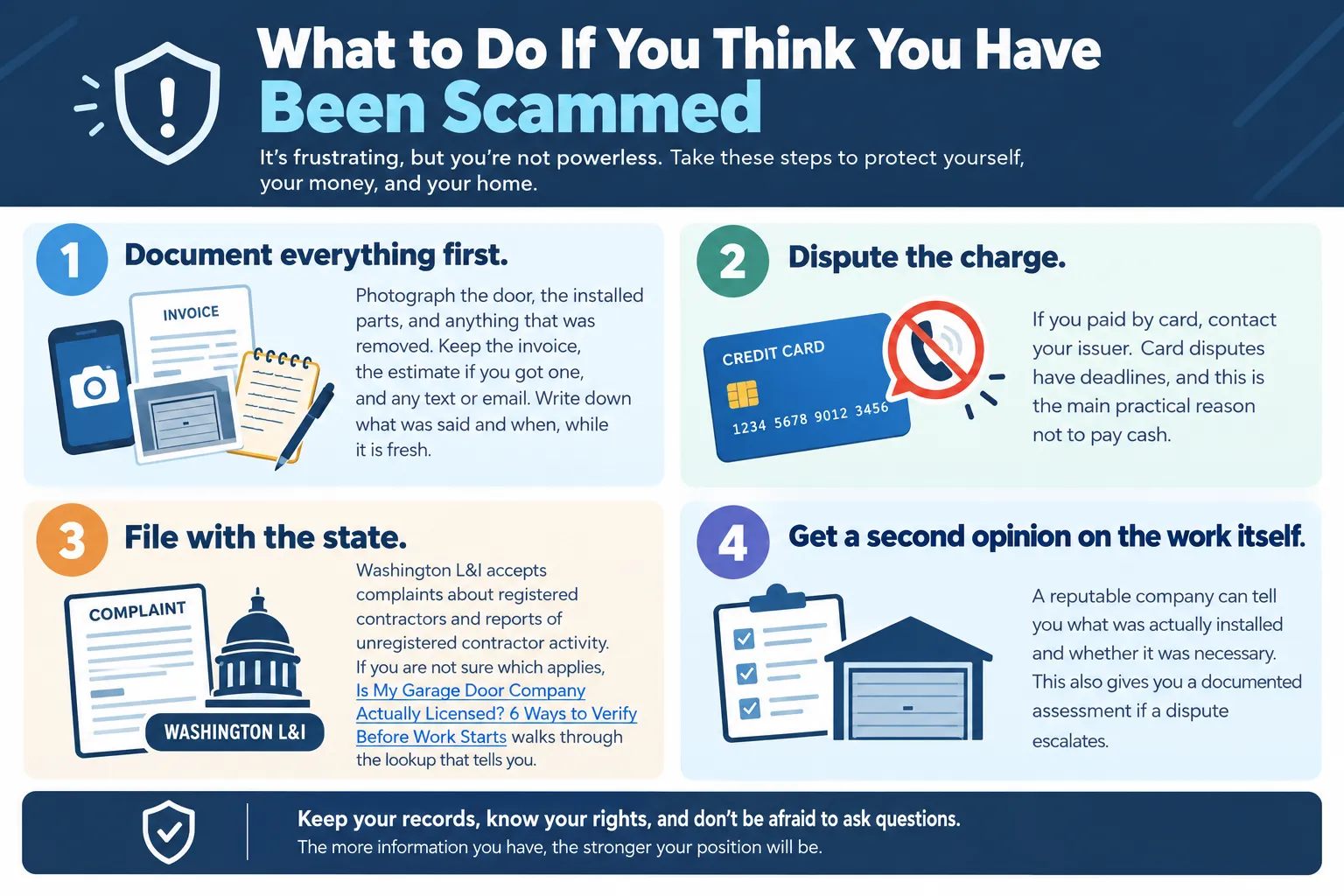
Act quickly, because several of the available routes are time-sensitive.
Document everything first. Photograph the door, the installed parts, and anything that was removed. Keep the invoice, the estimate if you got one, and any text or email. Write down what was said and when, while it is fresh.
Dispute the charge. If you paid by card, contact your issuer. Card disputes have deadlines, and this is the main practical reason not to pay cash.
File with the state. Washington L&I accepts complaints about registered contractors and reports of unregistered contractor activity. If you are not sure which applies, Is My Garage Door Company Actually Licensed? 6 Ways to Verify Before Work Starts walks through the lookup that tells you.
Get a second opinion on the work itself. A reputable company can tell you what was actually installed and whether it was necessary. This also gives you a documented assessment if a dispute escalates.
One safety note while you sort it out. If the door is stuck or a spring has failed, do not force it. Opening a garage door with a broken spring has a correct method and several dangerous ones, and a door under uncontrolled tension is genuinely capable of causing serious injury.
The Short Version
Most of this is catchable before anyone arrives. Ask for the company name and registration number on the phone, check them, and refuse to let work start without a written itemized price.
The rest comes down to one question you can ask in your own garage: show me the part that failed and tell me what it does. Nearly every tactic in this article falls apart at that question, because a script cannot answer it and a technician can.
Most homeowners only search for emergency garage door repair once something has already broken, which is the worst moment to be vetting anyone. Five minutes spent now, while nothing is wrong, is worth more than an hour spent later.
Garage Door Pros is an L&I-registered contractor serving Kirkland and the surrounding King County and Snohomish County communities, with written estimates before work begins and a registration number we will give you over the phone.
Want a second opinion, or a quote from a company you can verify first? Get in touch or call (425) 200-5902.


