


To verify a garage door company in Washington, ask for its 12-digit contractor registration number and look it up on the Department of Labor & Industries “Verify a Contractor” tool before anyone starts work. The record will show you four things that matter: whether the registration is active, whether the surety bond is current, whether liability insurance is in force, and whether the business name matches the one on your invoice. The whole check takes about two minutes on your phone. Most homeowners skip it, and most of the ones who get overcharged skipped it.
Key Takeaways
- Washington contractors carry a 12-digit registration number, not a trade license. There is no garage door exam in this state.
- A number existing is not the same as a number being active. Expired registrations look legitimate at a glance.
- Check the bond and the insurance separately. They cover different things and either can lapse on its own.
- The business name must match exactly across the L&I record, the vehicle, and the invoice. Mismatches are the most common tell.
- You can ask for the registration number on the phone, before dispatch. A real company gives it without hesitation.
- If the record does not check out, do not let the technician start. Once the door is apart, your leverage is gone.
Why This Check Exists in the First Place
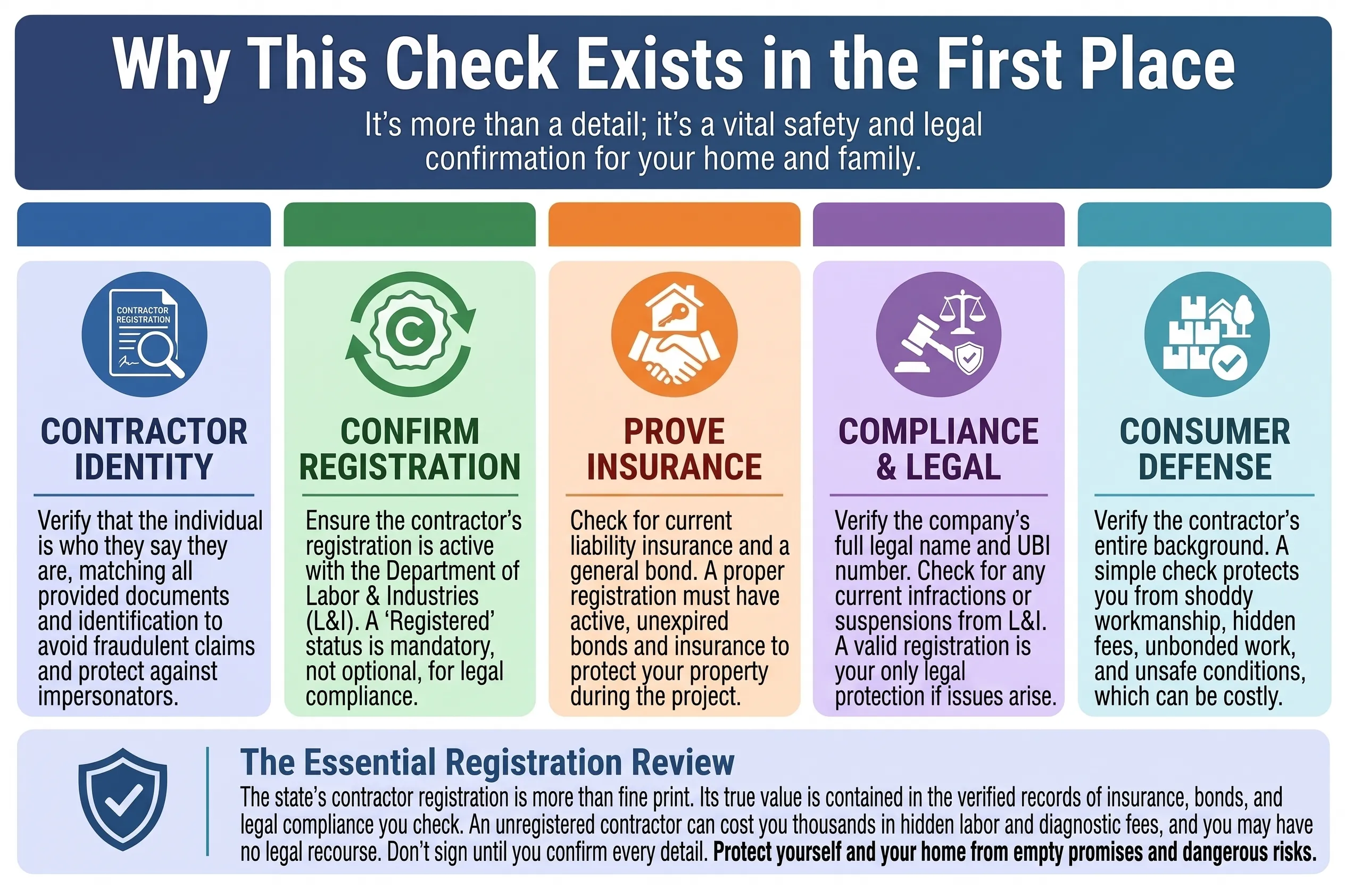
Washington does not license garage door contractors the way it licenses electricians or plumbers. There is no trade exam. Instead, the state registers contractors under RCW 18.27 and requires each one to post a surety bond and carry liability insurance.
That design matters for you as a homeowner. Because the state is not testing skill up front, the registration record is not a competence certificate. What it is, and what makes it genuinely useful, is proof that there is money behind the company if something goes wrong. A bond you can claim against. Insurance that covers damage to your property. A business the state can identify and act against.
An unregistered contractor has none of that. If they damage your door frame or take a deposit and vanish, your recovery options narrow to small claims court and hoping the business still exists.
This piece covers the verification step in detail. For the full hiring checklist that this sits inside, see How Do You Choose a Licensed Garage Door Company? 10 Things to Check Before You Hire.
1. Ask for the Registration Number Before Anyone Is Dispatched
Do this on the phone, not in the driveway. The moment to ask is while you still have every option open.
A registered Washington contractor has a 12-digit number and can recite it or read it off without any trouble. Ask for two things: the registration number and the exact legal business name it is registered under. Write both down.
The reaction tells you as much as the answer. A legitimate dispatcher has this information in front of them and treats the request as routine. Hesitation, deflection, or a promise that the technician will bring paperwork is a signal worth taking seriously.
How to Ask a Garage Door Company for Its License Number
Keep it simple and unapologetic. “Before I book, can I get your L&I registration number and the exact business name it’s under?” That is a normal question in Washington and no established company will find it unusual.
If they refuse: end the call. There is no legitimate reason to withhold a public registration number.
2. Run the Number Through L&I’s Contractor Lookup
Go to the Washington Department of Labor & Industries website and use the “Verify a Contractor, Tradesperson or Business” tool. You can search by the registration number or by business name.
Searching by number is more reliable. Business names in this industry are often similar to each other by design, and searching by name can surface a legitimate company with a near-identical name to the one that actually called you back.
If the number returns nothing, that is decisive. A registration number that does not resolve in the state database is not a registration number.
How to Look Up a Contractor License in Washington State
Do this yourself rather than accepting a screenshot. A screenshot can be old, edited, or from a different business entirely. The lookup is free, public, and takes under a minute.
If nothing comes up: the company is not registered, or gave you a number belonging to someone else. Either way, do not proceed.
3. Read the Status Line, Not Just the Record
This is the check that catches the most problems, and it is the one homeowners most often miss.
A record can exist and still be worthless. Washington registrations renew every two years, and a company that let its registration lapse still has a real record with a real number in the database. The difference lives in one field: the status.
You want to see active. What you do not want to see is expired, suspended, or revoked. An expired registration usually means the bond or the insurance lapsed, which is exactly the protection you were checking for.
Also look at the date the registration was first issued. A business that has been registered for years has a track record. One registered three weeks ago is not automatically a problem, but it deserves more scrutiny on the other checks.
What Does an Expired Contractor Registration Mean in Washington?
It means the financial backing is gone even though the paperwork still exists. The company may be mid-renewal and perfectly reputable, or it may have been dropped by its surety. You cannot tell which from the record, so treat it as a reason to ask directly and get a straight answer before scheduling.
If the status is not active: ask why, and do not schedule work until it is resolved.
4. Confirm the Bond Is Current and at the Right Amount
The L&I record shows the surety bond, the bonding company, and the bond amount. Check all three.
Washington raised its bond requirements on July 1, 2024. Specialty contractors now carry $15,000 and general contractors carry $30,000, up from the previous $6,000 and $12,000. A garage door company will typically be registered as a specialty contractor.
If you see an old amount on a current record, that is worth a question. It may simply be a display of a historical filing, or it may indicate the record has not been properly updated.
Understand what the bond is and is not. It is not insurance for you, and it is not a guarantee of good work. It is a pool the state holds that you can file a claim against if the contractor breaks the law, abandons the job, or fails to pay for materials. It is also finite and shared: if several customers claim against the same bond, it can be exhausted.
How Much Is a Garage Door Contractor’s Bond in Washington?
The bond is only half of the financial picture, and the half that gets more attention than it deserves. The insurance side is where property damage actually gets paid, and the two are covered together in Should a Garage Door Company Be Bonded and Insured? 5 Coverages to Confirm First.
If the bond shows as cancelled: stop. A cancelled bond and an active status line cannot both be true for long.
5. Check That Liability Insurance Has Not Lapsed
Insurance is a separate line on the record, and it lapses independently of the bond. Plenty of companies stay bonded while letting coverage drift.
Washington’s minimum is $200,000 public liability plus $50,000 property damage, or a $250,000 combined single limit. Those are floors, not benchmarks. For a garage door job, the realistic exposure is a damaged vehicle in the garage, a damaged door frame, or a structural issue with the header the opener mounts to.
Workers’ compensation is the piece homeowners almost never think about. Washington runs a state-fund system, so coverage comes through L&I rather than a private carrier. If an uninsured technician is injured in your garage, that exposure can find its way to you.
For a commercial property the stakes climb, because the equipment is larger and the downtime costs money. Whether you are arranging overhead door installation at a new facility or an overhead door repair on a dock that has to reopen tomorrow, confirm coverage in writing before the crew arrives.
What Insurance Should Be on File for a Garage Door Contractor?
Ask for a certificate of insurance naming the carrier and the policy dates. A company that carries real coverage can produce one the same day, because their broker sends them routinely.
If insurance shows as expired: do not let work begin, regardless of how the rest of the record looks.
6. Match the Business Name, Address, and Invoice
The last check is a comparison, and it is the one that catches deliberate deception rather than administrative sloppiness.
Line up four things: the legal business name on the L&I record, the name on the vehicle in your driveway, the name on the estimate or invoice, and the name the dispatcher used when they answered the phone. All four should be the same.
A mismatch is not always fraud. Companies do operate under a registered trade name, which is legitimate as long as that name is filed. But a registered contractor can tell you exactly how the two names relate. A vague explanation, or a different answer the second time you ask, is the actual warning sign.
Check the address the same way. Search it and see whether a real business appears there. Then check whether the company actually publishes the areas it serves, which a local operator will and a national lead-routing service will not.
Why the Business Name on the Invoice Has to Match the L&I Record
Because the bond and the insurance are filed under that exact name. If the invoice says something different, you may have no practical way to claim against either one, even though the record you checked was perfectly real.
Name inconsistency is also one of the most reliable markers of a scam operation generally. The guide to avoiding garage door scams published by Clopay makes the same point, noting that fraudulent operators often use generic or shifting names and lack a verifiable physical location.
If the names do not match: get a written explanation before work starts, not after.
What a Clean Record Looks Like
What you check | Clean record | Stop and ask |
Registration number | 12 digits, given freely on the phone | Withheld, or “the tech will bring it” |
Lookup result | Resolves to one clear business | No result, or several similar names |
Status | Active | Expired, suspended, or revoked |
Registration age | Years of continuous history | Registered within the last few weeks |
Bond | Current, $15,000 specialty minimum | Cancelled, or an outdated amount |
Insurance | In force, carrier named, dates current | Expired, or no certificate available |
Business name | Identical on record, van, and invoice | Different on any one of the three |
Address | Real location you can find on a map | Mailbox store, or none published |
What to Do If a Company Fails the Check
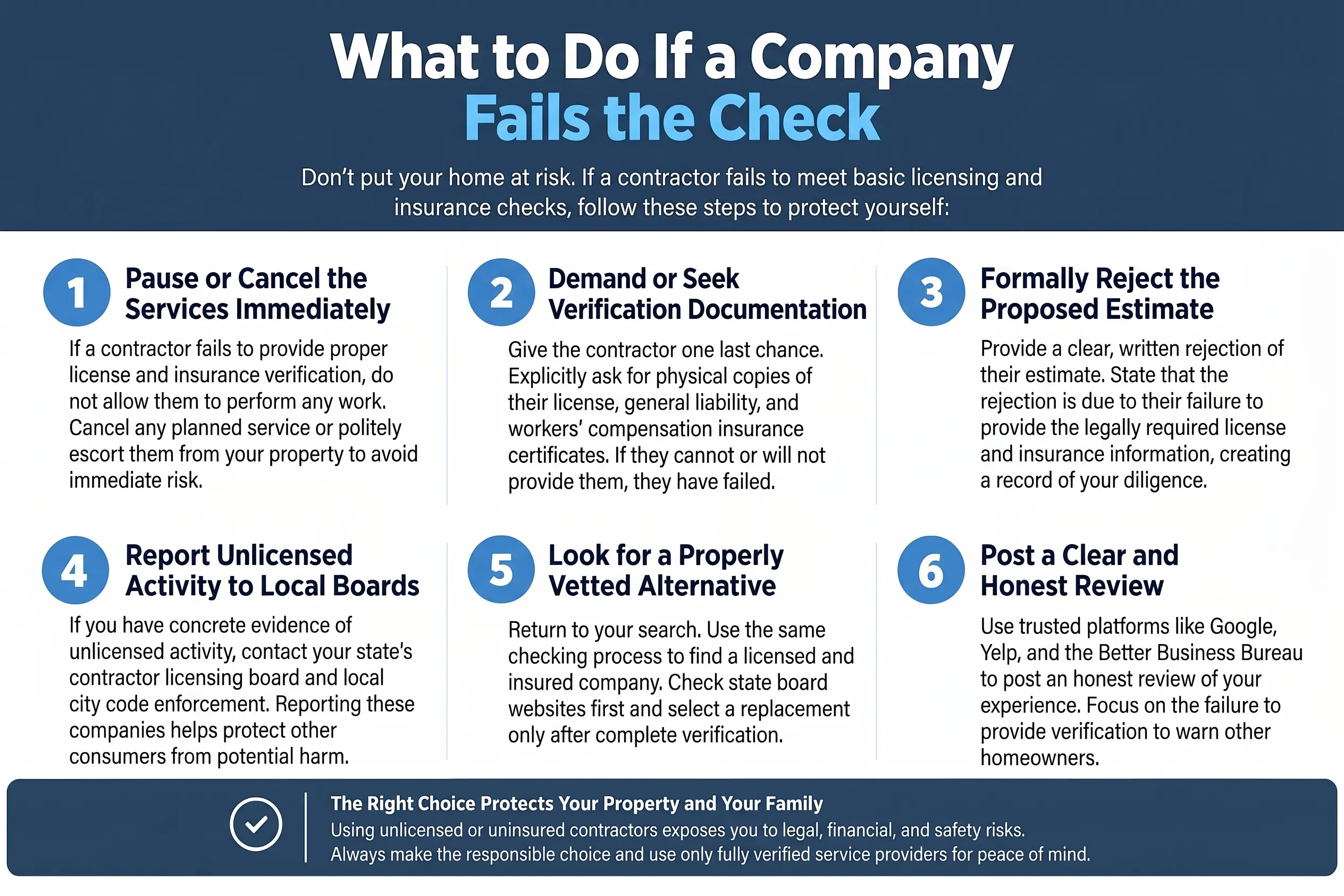
Do not let the technician start. This is the whole point of checking before rather than after, and it is easy to lose your nerve when someone is already standing in your driveway.
Say you have decided to get another quote. You do not owe an explanation, and you are not obligated to pay for a diagnosis you did not authorize in writing. If a service call fee was disclosed in advance, pay it and move on.
If you believe a company is operating without registration, Washington L&I accepts reports of unregistered contractor activity. The industry tracks this too. The International Door Association runs a consumer-facing program on this problem, and its scam awareness resources include a reporting form along with current guidance for homeowners. The association also shares ongoing updates through its industry channel on LinkedIn.
Verification is only one layer. The behavioral signals matter as much as the paperwork, and How Do I Spot a Garage Door Repair Scam? 8 Warning Signs Homeowners Miss covers the ones that show up before you ever get to a registration number.
One practical note while you wait for a second quote: if the door is stuck or a spring has failed, leave it alone. Garage door spring repair is genuinely dangerous work, and forcing a door with a broken spring is how a bad day becomes an injury. If you cannot wait, that is what emergency garage door service exists for, and an honest company will still quote you before touching anything.
The Short Version
Get the number on the phone. Look it up yourself. Read the status line. Check the bond and the insurance as two separate things. Make sure every name matches.
Five minutes of work, done before the technician arrives rather than after the door is in pieces. It will not tell you whether someone is good at their job, but it will tell you whether there is anything standing behind the work, and that is the part you cannot fix later.
Garage Door Pros is an L&I-registered contractor serving Kirkland and the surrounding King County and Snohomish County communities, with written estimates before work begins and technicians who will give you the registration number before they are dispatched.
Want a quote from a company you can verify first? Get in touch or call (425) 200-5902.


