

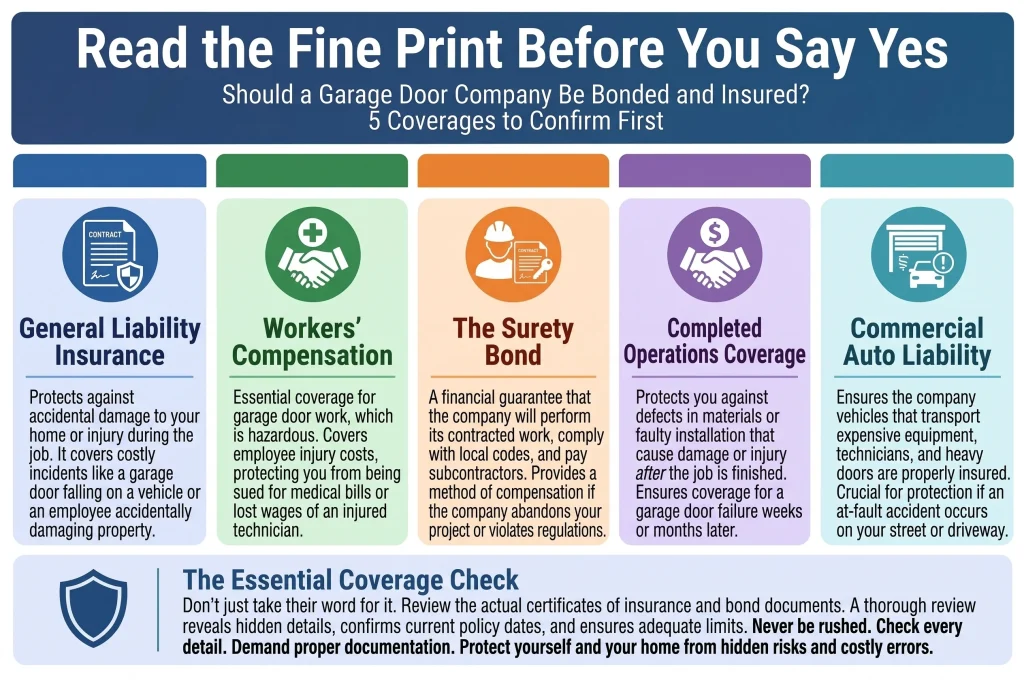
Yes, and in Washington it is not optional: a registered contractor must carry a surety bond and liability insurance to operate legally. But “bonded and insured” is a marketing phrase as often as it is a fact, and the two words cover completely different things. The bond protects you if the contractor abandons the job or breaks the law. The insurance protects you if they damage your property. Either one can lapse without the other. Before work starts, confirm five things: general liability, workers’ compensation, the surety bond, completed operations coverage, and commercial auto liability.
Key Takeaways
- Bonded and insured are not synonyms. The bond is a state-held fund; insurance is a private policy. Check them separately.
- General liability is the coverage you are most likely to actually use, because property damage is the most common thing that goes wrong.
- Washington sets minimum limits for public liability and property damage. Those are legal floors, not standards to aim for.
- Specialty contractors post a smaller bond than general contractors. Both amounts increased in 2024.
- Workers’ compensation is the one homeowners forget. An uninsured technician injured in your garage becomes your problem.
- Ask for a certificate of insurance, not a verbal assurance. A company with real coverage can produce one the same day.
Why “Bonded and Insured” on a Van Means Nothing by Itself
Nobody checks. That is the entire reason the phrase works as advertising.
A company can print “licensed, bonded and insured” on a vehicle, a business card, and a website footer with no one verifying any of it. The claim costs nothing to make. What costs money is actually maintaining the coverage, and that is the gap where problems live.
The useful move is to stop treating it as one claim and start treating it as five separate questions, each with a document behind it. This article covers those five. For the wider hiring checklist this belongs to, see How Do You Choose a Licensed Garage Door Company? 10 Things to Check Before You Hire.
One framing worth holding onto: none of this tells you whether a company does good work. It tells you whether there is money behind the work if it goes badly. Those are different questions, and this is only the second one.
1. General Liability Insurance
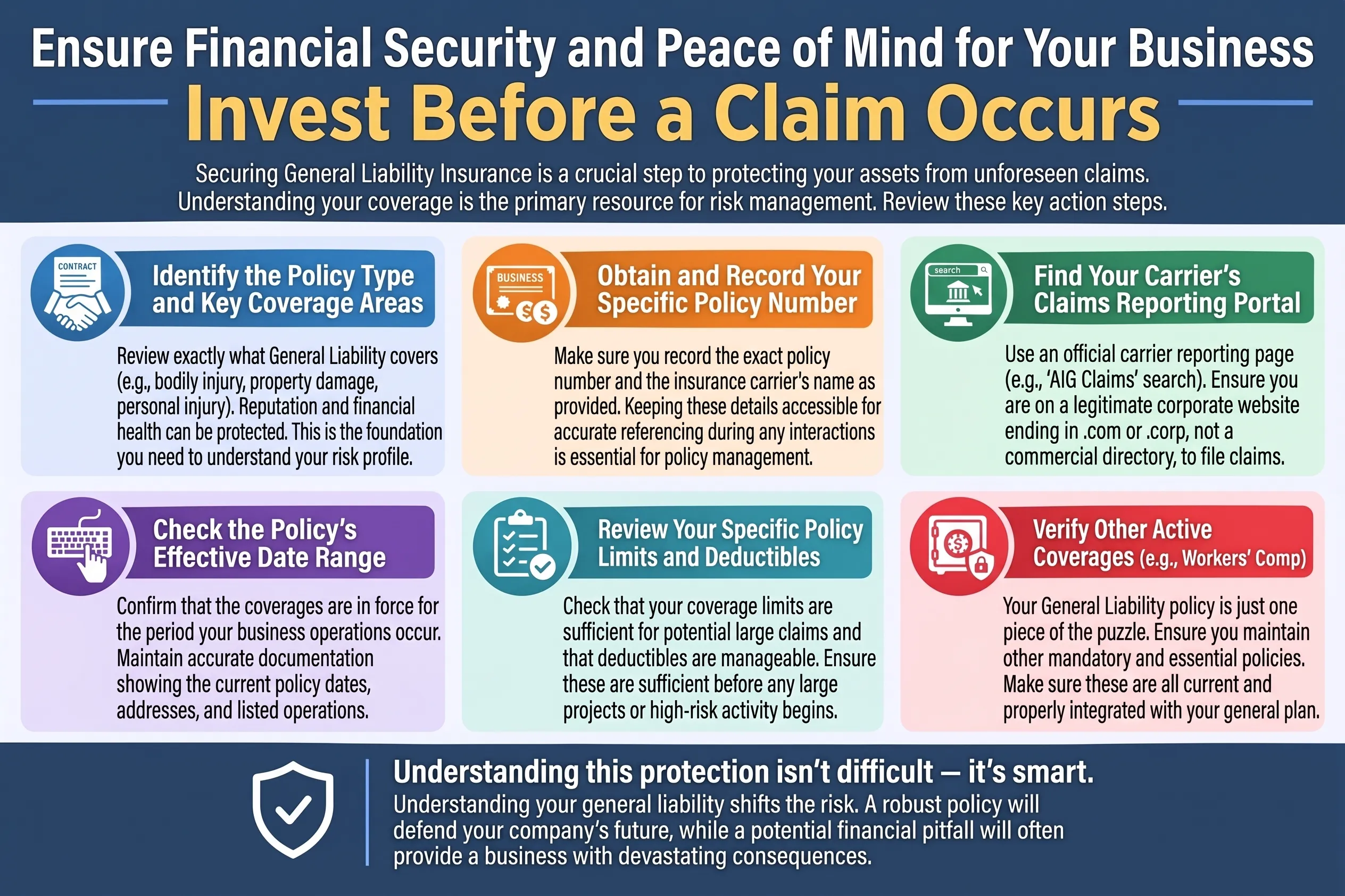
Start here, because this is the coverage you are statistically most likely to need.
General liability pays for damage the contractor causes to your property. In garage door work the realistic scenarios are specific: a panel dropped onto a vehicle, a damaged header where the opener mounts, a torn drywall ceiling from a misjudged rail installation, or a door frame split during removal.
Washington sets a minimum for public liability and a separate, much lower minimum for property damage. Pay attention to that second figure when you see it on a certificate. The property damage floor sounds generous in the abstract until you consider that a single car parked in the garage can consume most of it.
The number to weigh it against is the value of what is actually in the room. On a job like a full door installation, the crew is handling large panels in a space that usually contains at least one vehicle.
What Does a Garage Door Contractor’s Liability Insurance Cover?
Damage to your property caused by the contractor’s work. It does not cover defective workmanship itself, which is what a warranty is for, and it does not cover injury to the contractor’s own employees, which is what workers’ compensation is for.
Ask for: a certificate of insurance showing the carrier, the policy number, the limits, and the expiration date.
2. Workers’ Compensation
This is the coverage homeowners almost never ask about and the one with the most uncomfortable downside.
If a technician is injured in your garage and has no workers’ compensation coverage, the question of who pays does not simply disappear. It can land on your homeowner’s policy, and in some circumstances on you directly.
Washington handles this differently from most states. It runs a monopolistic state fund, so coverage comes through L&I rather than a private carrier. That has one useful side effect for you: workers’ comp account status appears on the same state record as the contractor registration, so you can check it in the same lookup.
Garage door work carries real injury exposure, which is why this matters more than it does for, say, a painter. Torsion springs store enough energy to cause serious harm, and cable repair puts a technician’s hands directly next to components under load. On commercial jobs the equipment is larger still, and a crew performing overhead door repair on a dock door is working with assemblies that weigh several times what a residential door does.
Do I Need to Worry About Workers’ Comp for Garage Door Repair?
Yes, if the technician is not covered. Ask directly whether technicians are employees of the registered business or subcontracted labor. Employees fall under the company’s account. Subcontractors need their own, and that is a separate thing to verify.
Ask for: confirmation that technicians are employees, and check the workers’ comp status on the state record.
3. The Surety Bond
The bond is the most advertised of the five and the most misunderstood.
It is not insurance for you. It is a fixed sum, held through a surety company and filed with the state, that you can make a claim against in specific circumstances: the contractor abandons the job, violates contracting law, or fails to pay for materials or labor on your project.
Washington raised the required amounts in 2024, roughly doubling both categories. Specialty contractors post the smaller of the two bonds, and a garage door company is normally registered as a specialty contractor.
Two limitations matter. First, the bond is finite and shared across all claimants, so if several customers claim against the same bond in the same period, it can be exhausted. Second, claiming against it is a legal process, not a phone call.
Permits are a related piece of the same compliance picture. Work that requires a permit and does not get one can create problems at resale, and knowing when a permit is needed to replace a garage door is worth checking before a larger job rather than after.
What Does a Contractor Bond in Washington Actually Cover?
Abandonment, contracting law violations, and unpaid suppliers on your project. It does not cover accidental property damage, which is what general liability insurance is for. If the amount on the record looks like one of the older, lower figures, that is worth one question.
Ask for: the bonding company name and confirmation the bond is current, both visible on the L&I record.
4. Completed Operations Coverage
This is the one that separates a thorough check from a superficial one, because it covers the failures that do not show up on the day.
Completed operations is a component of general liability that responds to damage caused by finished work. A bracket that loosens three months later and lets a door come down. A poorly mounted opener that eventually pulls away from the header. These are not same-day failures, and a policy without this component may not respond to them.
Ask specifically whether the general liability policy includes products and completed operations, and whether that coverage continues after the job closes. Do not accept “we’re covered” as an answer to this one, because the person saying it often does not know.
It is also worth understanding the boundary between insurance and warranty here. Insurance covers damage caused by the work. Warranty covers the work itself failing. A loose bracket that damages your car is potentially an insurance matter; the same bracket simply failing is a warranty matter. Both should be in writing.
For larger jobs the stakes scale with the equipment. An overhead door replacement involves hardware that will be cycling for years, and ongoing garage door maintenance is part of what keeps a completed installation from becoming a completed-operations claim in the first place.
Does Insurance Cover Garage Door Work After the Job Is Finished?
Only if the policy includes products and completed operations coverage. Confirm it explicitly, and confirm it appears on the certificate of insurance rather than taking it on trust.
Ask for: the completed operations line on the certificate, and the separate written warranty.
5. Commercial Auto Liability
The smallest of the five and the easiest to forget, because the vehicle does not feel like part of the job.
A service truck reverses down your driveway with a technician spotting from the garage. If it contacts your car, your fence, or your garage door, that is an auto claim rather than a general liability claim, and a company operating personal vehicles on commercial work may find the claim disputed.
This matters most where vehicles are largest and driveways are tightest, which in practice means older neighborhoods and commercial properties with loading areas.
Should a Garage Door Company Carry Commercial Auto Insurance?
Yes, if they operate marked service vehicles, which any established company does. It is a reasonable line item to see on the certificate of insurance, and its absence on a company running a fleet is worth a question.
Ask for: commercial auto listed on the certificate alongside general liability.
What Each Coverage Actually Pays For
Coverage | Pays for | Protects | Without it |
General liability | Damage to your property from the work | You | Damage comes out of your own policy or pocket |
Workers’ compensation | Injury to the technician on your property | You and the technician | Exposure can reach your homeowner’s policy |
Surety bond | Abandonment, legal violations, unpaid suppliers | You | No fund to claim against; small claims court |
Completed operations | Damage from finished work, months later | You | Later failures may not be covered at all |
Commercial auto | Vehicle damage on your property | You | Disputed claim, personal auto policy |
How to Actually Check, Rather Than Just Ask
Asking produces an answer. Checking produces evidence. There are three steps, and none takes long.
Pull the state record. The bond and the workers’ comp account both appear on the L&I contractor record, alongside the registration status. That single lookup covers two of the five. The full walkthrough is in Is My Garage Door Company Actually Licensed? 6 Ways to Verify Before Work Starts.
Request the certificate of insurance. This is a standard one-page document that brokers issue routinely, and it shows the carrier, the policy numbers, the limits, and the dates. A company with real coverage can have one sent to you within a day. A company that cannot produce one has told you something.
Read the dates. A certificate is a snapshot, and an expired one is common enough to be worth checking deliberately. Confirm the policy period covers the date your work is scheduled.
For commercial clients there is a fourth step. Ask to be named as additional insured on the policy for the duration of the job. This is routine on commercial door projects, whether that is an overhead door installation at a new facility or scheduled door maintenance across multiple openings, and any contractor who works commercially will know exactly what you are asking for.
Warning Signs Around Insurance Claims
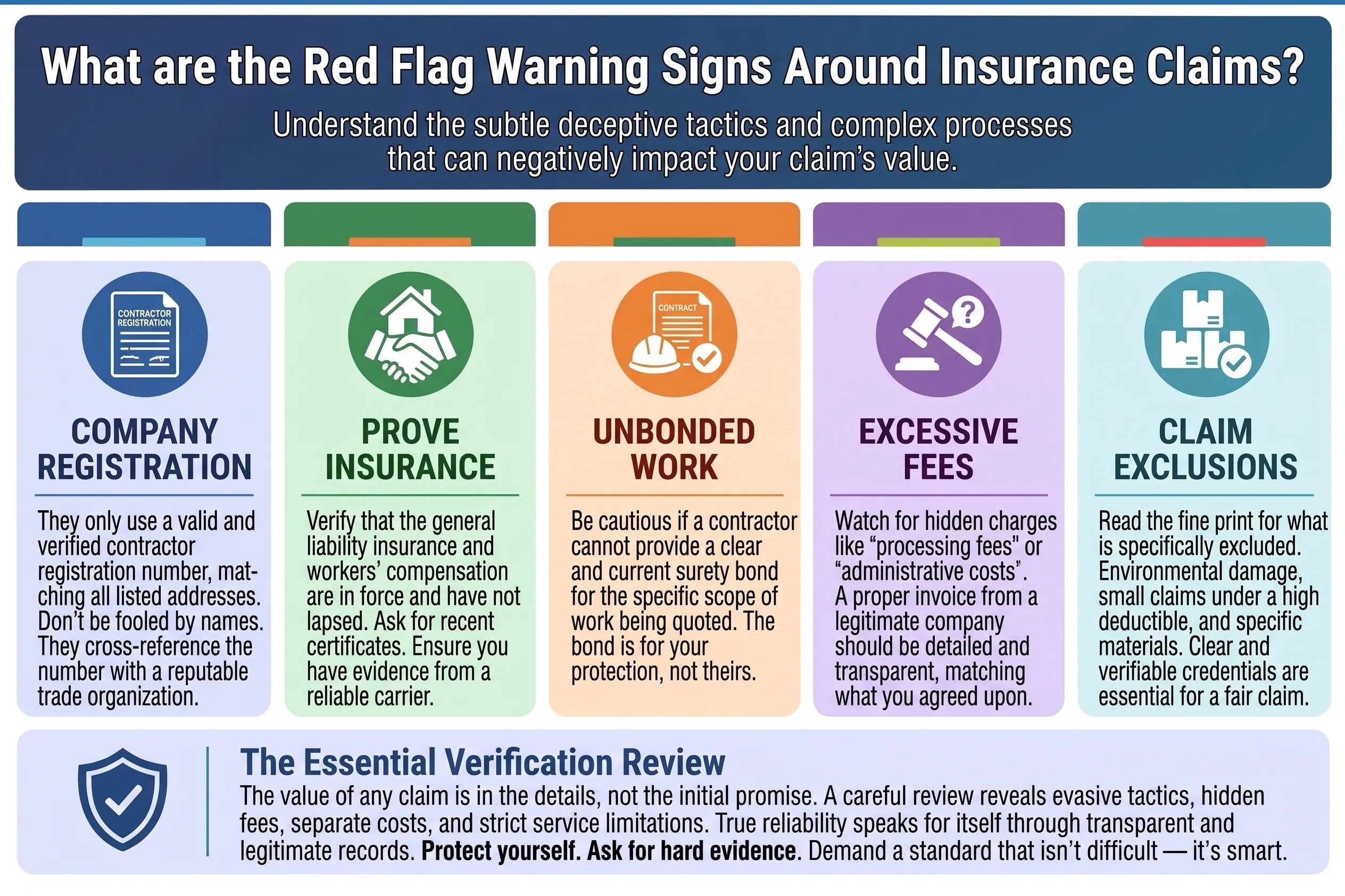
Certain patterns show up often enough to be worth naming.
A company that says “fully insured” but will not name the carrier. A certificate that arrives as a low-resolution image rather than a document from a broker. Limits quoted from memory that change between the phone call and the driveway. A business name on the certificate that does not match the name on the estimate, which makes the coverage effectively unusable to you.
That last one connects to a broader pattern. Clopay’s consumer guidance on garage door scams notes that fraudulent operations frequently use generic or inconsistent business names and lack a verifiable physical location, which is exactly the condition that makes a certificate worthless even when it is real.
The behavioral signals usually arrive before the paperwork ones, and How Do I Spot a Garage Door Repair Scam? 8 Warning Signs Homeowners Miss covers the ones you can read in the first two minutes of a phone call.
If you believe a company is working uninsured, this is a reportable problem. Washington L&I accepts reports of unregistered contractor activity, and the trade association side has its own channel: the International Door Association maintains scam awareness resources with a reporting form and current consumer guidance, and publishes ongoing updates through its industry account on LinkedIn.
The Short Version
Five coverages, three of which you can confirm from a state record and a single one-page certificate. General liability for damage to your property. Workers’ compensation for injury to the technician. The bond for abandonment. Completed operations for failures that surface later. Commercial auto for the truck in your driveway.
The phrase on the van proves nothing. The certificate and the state record prove most of it, and both are free to look at.
Garage Door Pros is an L&I-registered contractor serving Kirkland and the surrounding King County and Snohomish County communities. You can read more about the company, and you are welcome to ask for the registration number and certificate of insurance before anything is scheduled.
Want a quote from a company you can verify first? Request a free quote or call (425) 200-5902.


