


To choose a licensed garage door company in Washington, verify the contractor’s registration number on the state Labor & Industries website before anyone touches your door. Washington does not issue a garage-door-specific license. Instead, contractors register with L&I under RCW 18.27 and must carry a surety bond and liability insurance. A legitimate company will have an active 12-digit registration number, a bond on file, current insurance, a real local address, and a written estimate they will hand you before work starts. If a company cannot produce all five, that is your answer.
Key Takeaways
- Washington requires contractor registration, not a trade license. There is no garage door exam, so registration plus bond plus insurance is the real credential.
- Specialty contractors must carry a $15,000 surety bond; general contractors carry $30,000. Both must hold liability insurance.
- Verify the registration yourself on L&I’s contractor lookup. Do not accept a number printed on a business card as proof.
- Get the estimate in writing before work begins. Verbal quotes are where most overcharging starts.
- Pressure to decide immediately, a vague company name, and no verifiable address are the three most reliable warning signs.
- If a company is not registered and something goes wrong, your options for recovering money shrink dramatically.
1. Is the Company Actually Registered With Washington L&I?
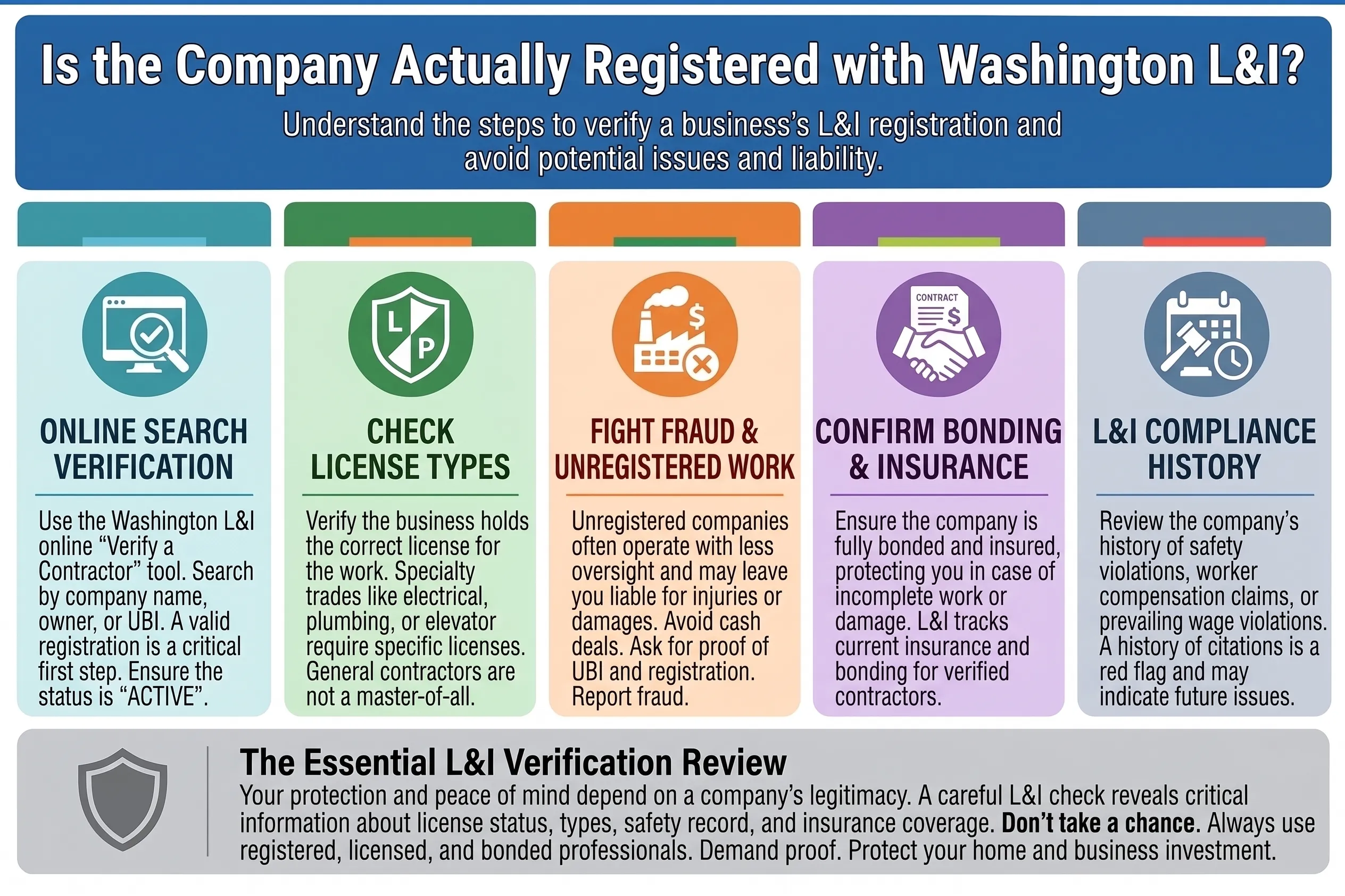
Start here, because everything else depends on it. A registered contractor has filed with the Washington Department of Labor & Industries, posted a bond, and proven insurance coverage. An unregistered one has done none of that and is operating illegally.
Ask for the company’s 12-digit contractor registration number, then check it yourself on L&I’s “Verify a Contractor” tool. You are looking for four things: the status reads active, the business name matches the name on the truck and the invoice, the bond is current, and the insurance has not lapsed.
The common failure here is not a fake number. It is an expired one. A company that registered three years ago and let the bond lapse still has a real-looking number, and most homeowners never check the status line.
How to Verify a Garage Door Contractor License in Washington State
The full walkthrough, including what each field on the L&I record means and what to do when the name on the record does not match the name on the van, is covered in Is My Garage Door Company Actually Licensed? 6 Ways to Verify Before Work Starts.
Walk away if: the company will not give you a registration number, gives you one that does not resolve, or tells you garage door work does not require registration in Washington. It does.
2. Are They Bonded and Insured, and for How Much?
Bonding and insurance decide who pays when a job goes wrong. They are not the same thing, and homeowners routinely treat them as interchangeable.
The bond is a pool of money the state holds against the contractor. If they take your deposit and disappear, or leave work unfinished, you can file a claim against it. Since July 2024, Washington requires $15,000 for specialty contractors and $30,000 for general contractors, raised from the previous $6,000 and $12,000.
Liability insurance is separate and covers property damage. Washington’s minimum is $200,000 public liability plus $50,000 property damage, or a $250,000 combined single limit. Workers’ compensation matters too: Washington runs a state-fund system, and if an uninsured technician is injured on your property, that exposure can land on you.
What Insurance Should a Garage Door Repair Company Carry?
Coverage limits, what the bond will and will not pay for, and how to request a certificate of insurance are broken down in Should a Garage Door Company Be Bonded and Insured? 5 Coverages to Confirm First.
Walk away if: they describe themselves as “fully insured” but will not name the carrier or produce a certificate.
3. Does the Company Handle Your Type of Door?
A residential sectional door and a commercial rolling steel door are different systems with different hardware, different cycle ratings, and different safety requirements. Plenty of companies advertise both and are only set up for one.
If you are a homeowner, ask what brands they install and whether they service openers as well as doors. If you run a business, the question is sharper. Commercial work involves high-cycle hardware, operator control stations, and loading dock systems that a residential crew will not have on the truck.
For business owners, confirm the company genuinely performs overhead door installation, handles overhead door repair on your operator type, and can quote overhead door replacement when a door has reached the end of its service life. A company that only does residential work will subcontract it, and you lose your direct line of accountability.
Why Commercial and Residential Garage Door Companies Are Not Interchangeable
It helps to know what you are actually asking about. The parts of a garage door system differ enough between residential and commercial setups that a technician who works on one daily may be guessing on the other.
Walk away if: they cannot tell you what door type you have after looking at it.
4. Will They Put the Estimate in Writing Before Starting?
A written estimate before work begins is the single most effective protection you have. It converts a conversation into a document, and it makes an upsell on the spot much harder.
A usable estimate lists the specific parts being replaced, the labor charge, the service call fee and whether it is applied to the repair, the total, and the warranty term. If it says “garage door repair” and a number, it is not an estimate.
Be specific about the service call. A widely used tactic is to advertise a very low service fee, then discover expensive problems once the technician is on site. Ask what the fee covers and whether it comes off the final bill.
On pricing generally, know the range before you call. A tune-up, a spring replacement, and a full opener swap sit at very different price points, and our own breakdowns of what a garage door tune-up costs and whether repair or replacement is cheaper will tell you when a quote is out of proportion.
What Should Be Included in a Garage Door Repair Estimate?
Get the estimate before the technician starts, not after. Once the door is disassembled, your negotiating position is gone.
Walk away if: they want a large deposit in cash before any work, or refuse to write anything down.
5. What Does the Warranty Actually Cover?
Warranty is where the fine print does real damage. There are usually two separate warranties: the manufacturer’s warranty on the part, and the company’s warranty on the labor. A company can honor the first and offer nothing on the second.
Ask three questions. How long is the labor warranty? Does it cover a return visit at no charge? And is it transferable if you sell the house?
Watch for warranties that are voided by normal maintenance. Some companies write terms that lapse if anyone else touches the door, which effectively locks you in.
How Long Should a Garage Door Repair Warranty Last?
Terms vary widely by company and by part. Springs, openers, and labor are typically warranted on different schedules, so ask for each one separately rather than accepting a single blanket figure.
Walk away if: the warranty is verbal only, or the term changes when you ask a second time.
6. Who Is Actually Showing Up at Your House?
You are letting a stranger into your garage, which in most homes is an interior door away from the rest of the house. This is a legitimate thing to ask about.
Confirm whether technicians are employees or subcontractors. Employees are covered by the company’s workers’ comp and insurance, and the company carries responsibility for their work. Subcontractors introduce a gap. Ask whether technicians are background-checked, whether they arrive in a marked vehicle, and whether they carry company ID.
An unmarked truck is not automatically a problem, but combined with a company name you cannot verify, it is a pattern that consumer reporting has repeatedly flagged.
Are Garage Door Technicians Background Checked?
Reputable companies answer this question directly and without hesitation. It is a normal question and they get asked it.
Walk away if: the person who arrives works for a different company than the one you called.
7. Are They Pressuring You to Decide Right Now?
Urgency is the mechanic that makes garage door overcharging work. The door is stuck, the car is trapped, and someone in your driveway says the whole system needs replacing today.
Real emergencies exist. A broken spring genuinely does immobilize a door, and a door off its track is a real safety hazard. But a legitimate technician explains the failure, shows you the part, and gives you the option to think about it. A scammer manufactures a deadline.
The International Door Association has noted that media coverage points to a widespread pattern of garage door scams, with victims frequently targeted during emergencies and pressured into paying inflated prices, and has urged homeowners to verify credentials and avoid upfront payments. You can read the association’s scam awareness resources for the current reporting and consumer guidance.
How to Tell a Real Garage Door Emergency From a Sales Tactic
The tells are consistent enough to list. How Do I Spot a Garage Door Repair Scam? 8 Warning Signs Homeowners Miss goes through each one and what to say when you see it.
If the situation genuinely is urgent, that is what emergency garage door service is for, and an honest company will still quote you first.
Walk away if: the price drops sharply the moment you say you want a second opinion.
8. Can You Find Them at a Real, Consistent Address?
This check takes two minutes and eliminates a large share of bad actors.
Search the company’s address on Google Maps. Does a real business appear there? Does the name match the website, the invoice, and the way they answered the phone? Clopay’s consumer guidance makes the same point: scam operations often use generic or inconsistent names and lack a legitimate physical location, and the name a company gives when answering the phone should match its website and advertising. Their guide to avoiding garage door scams walks through the phone-call tells in detail.
Also check that the company actually serves your area rather than routing your call to whoever is nearest. A company with published service areas has a footprint you can check. A national-sounding call center does not.
How to Check If a Garage Door Company Is Local
Reviews help here, but read the content rather than the star rating. Specific reviews that name a technician, a neighborhood, and a repair are hard to fake. Generic five-star reviews posted in a cluster are not.
Walk away if: the address is a mailbox store, or no address is published at all.
9. Do They Stock Parts for Your Brand?
A company that carries common springs, rollers, cables, and opener parts on the truck can finish the job in one visit. A company that does not will either order the part and return, or install whatever generic component they have, which is how mismatched hardware ends up on a door.
Ask what opener brands they service and whether they stock parts for yours. If you have a LiftMaster, Chamberlain, Genie, or similar, that should be a simple yes.
This matters for springs in particular. Springs are rated by cycle life, and installing an underrated spring saves the company money and costs you a replacement in a couple of years.
What Garage Door Parts Should a Technician Carry on the Truck?
Springs are also the part you should never attempt yourself. They hold enough stored energy to cause serious injury, which is why garage door spring repair is a pro-only job regardless of how confident you are with tools.
Walk away if: they cannot tell you the cycle rating of the spring they are installing.
10. What Happens After the Repair Is Finished?
The last check is about the relationship, not the transaction. A company that wants to be there in five years behaves differently from one optimizing for a single invoice.
Ask what maintenance the system needs and how often. Ask whether they offer a tune-up schedule. Ask what they would watch for on a door of this age. A technician who gives you a straight answer, including “this door is fine, leave it alone,” is one worth keeping.
For businesses, scheduled door maintenance is usually cheaper than reactive repair, because downtime on a commercial opening costs more than the service visit. For homeowners, regular garage door maintenance catches worn cables and failing rollers before they strand a car.
How Often Should a Garage Door Be Serviced?
Most residential doors do well with an annual inspection. High-cycle commercial doors need more. There is also a reasonable amount you can do yourself between visits, and what you can safely service on your own garage door draws the line between the two.
Walk away if: every conversation ends in a quote for something new.
Green Light vs. Walk Away: A Quick Reference
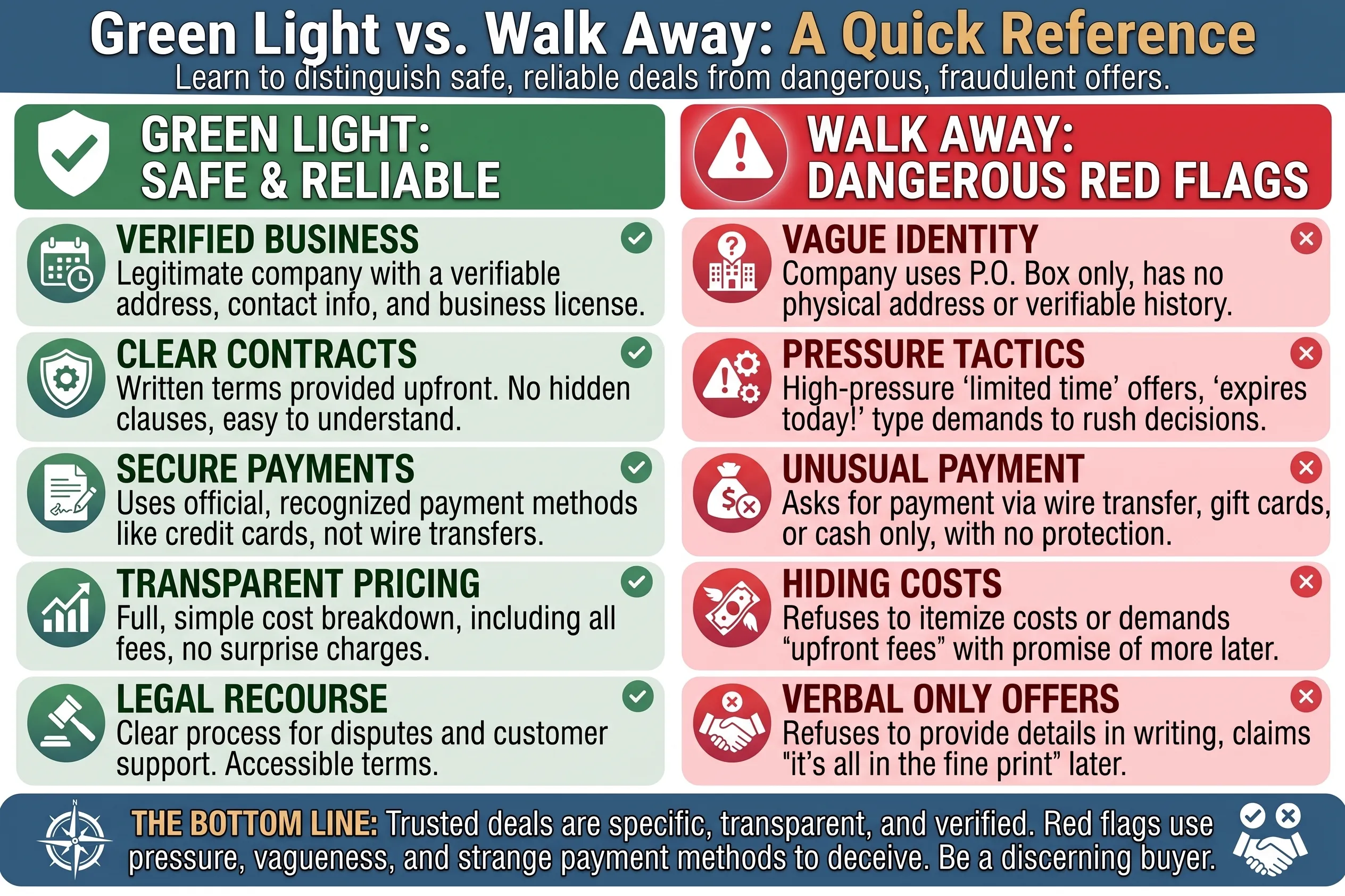
What you check | Green light | Walk away |
L&I registration | Active 12-digit number, name matches | No number, expired, or name mismatch |
Bond | Current, $15,000 specialty minimum | Cannot confirm, or claims none needed |
Insurance | Names the carrier, provides certificate | Says “fully insured,” offers no proof |
Estimate | Written, itemized, before work starts | Verbal only, or written after the fact |
Service call fee | Stated up front, applied to repair | Advertised low, charges appear later |
Warranty | Written, parts and labor stated separately | Verbal, or terms shift when questioned |
Technicians | Employees, marked vehicle, company ID | Unmarked truck, unclear employer |
Pressure | Explains, shows the part, lets you decide | Today-only pricing, drops price if you hesitate |
Address | Real location, consistent across all listings | Mailbox store, or no address published |
Payment | Invoice, normal payment methods | Large cash deposit demanded up front |
The Short Version
Registration, bond, insurance, a written estimate, and a verifiable address. Five things. A company that clears all five is very unlikely to be the one that overcharges you, and a company that fails any one of them has told you something useful.
Washington makes the first three easy to check, and the check takes about five minutes on your phone while the technician is still in the driveway. It is worth doing before the door comes apart, not after.
Garage Door Pros has served Kirkland and the surrounding King County and Snohomish County communities for more than 20 years, with L&I-registered technicians, written estimates before work begins, and same-day availability seven days a week.
Need a door looked at by someone you can verify? Request a free quote or call (425) 200-5902.


